

Dartmoor isn’t a Museum Piece. It’s a Working Landscape.
Ponies, cattle, sheep, and commoners are part of how it is managed, and when the paperwork becomes impossible, the land drifts into neglect.


I watched the Dartmoor pony row unfold the way so many countryside stories do now. A headline lands, people pick a side, and within hours we are no longer talking about land management at all. We are talking about villains and victims.
The version that travelled was simple. Natural England changed the rules. The ponies would be culled. The moor would be “saved” or “destroyed” depending on who you ask, and I fell for it too.
The Times headline that got me was “Dartmoor ponies could be put to death under biodiversity plans”, paired with the kind of figures that make your stomach drop. The reported figures were a 75% reduction in grazing animals, and claims that up to nine in ten ponies could be culled. Those numbers may or may not be where this ends up, but they were enough to set the story running.
That is exactly why I am not writing this to defend Natural England, or to join the pile-on. I am writing because the mechanism matters. When a living landscape gets turned into guidance, quotas, and compliance language, it becomes very easy for everyone involved to dodge responsibility for what happens next. If you care about Dartmoor, you have to care about how decisions get made, how incentives land on real people, and what gets quietly lost when grazing is treated as a problem rather than a tool.
How the story travelled
A big part of the heat came from how the story was framed.
Patrick Galbraith’s Telegraph article’s are a good example of the wider narrative Dartmoor got folded into. In his piece that sits inside the wider anti-quango narrative, with “quangocracy” as the hook, Dartmoor sits alongside jumping spiders near Ebbsfleet, the HS2 bat tunnel, and the Hinkley “fish disco”. The effect is to make every conservation decision feel like either common sense or madness, and to push readers away from the messy middle, which is where most of the truth lives.
Danica Priest, writing on Substack, does something different. She slows it down and asks what has actually changed, what is being counted, and what the downstream effects might be. Her central point is that the viral “pony cull” framing is not the policy. It is the interpretation. The real story is a change in how grazing is counted inside an optional funding scheme, the kind of scheme that looks voluntary on paper but becomes hard to ignore once money and compliance are tied to it. A technical shift like that can end up functioning as a decision once livelihoods and paperwork collide.
Because the question is not only “are the ponies safe”. The question is what happens when counting rules and guidance start doing the work of decision-making, and nobody wants to own the consequences.
Why I am wary of “guidance”
I cannot read the Dartmoor pony row without thinking about my own run-in with Natural England, not because pigs and ponies are the same, but because the pattern is familiar.
Back in 2020, when my partner and I were starting out, we took on a small woodland grazing tenancy on land that was considered part of Odiham Common. The grassland was an SSSI, and the woodland had not been managed for around twenty years. It was overgrown, full of invasive and non-native species, and it needed active management.
We bought twelve Saddleback weaners and did the hard, unglamorous work of making that site workable. We cut back growth to build a training pen. We planned rotational grazing with electric fencing. Access was via a narrow path around a pond and over a wooden bridge, which meant moving pigs in and out was never straightforward.
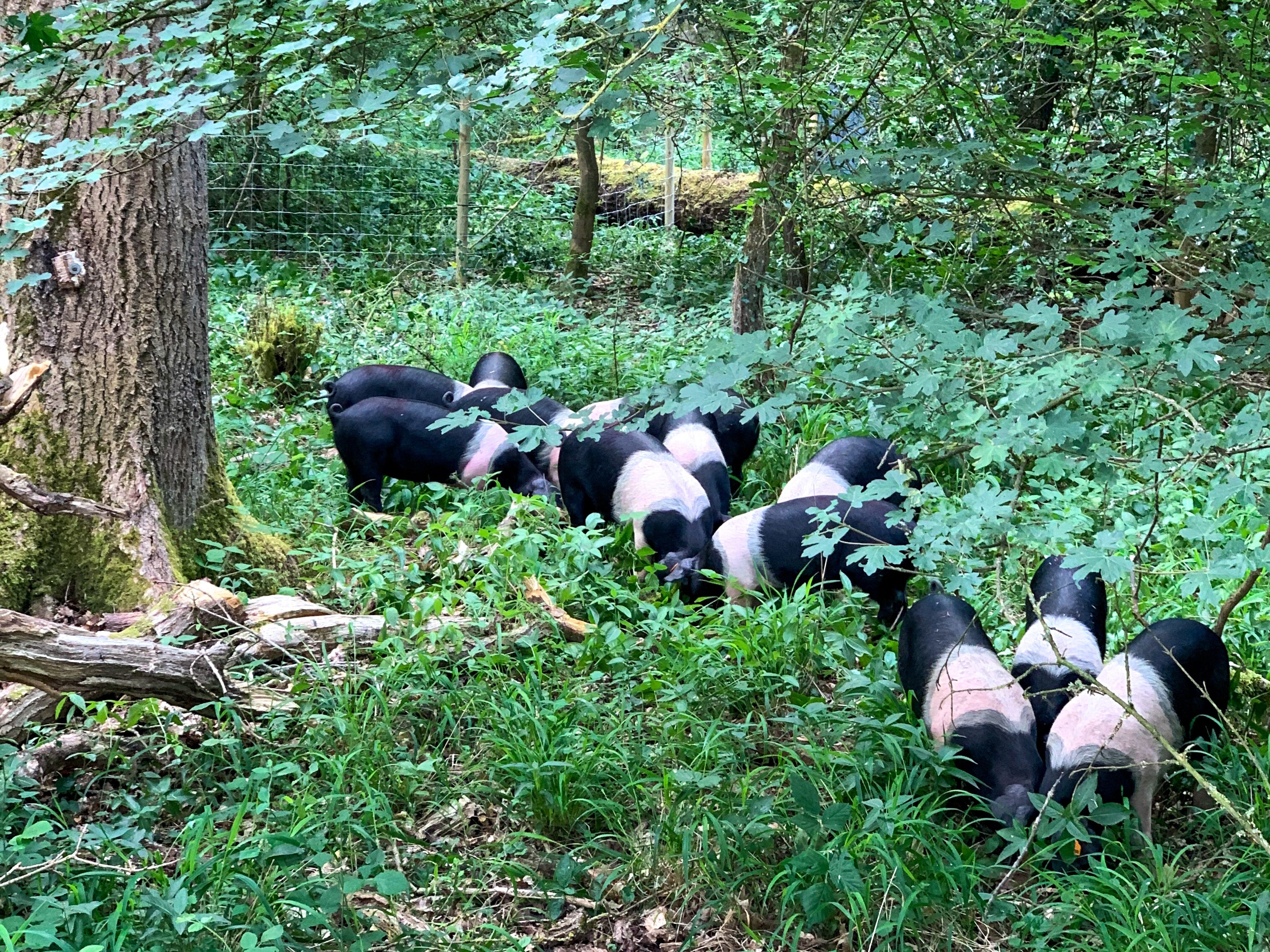
I still remember the day we eventually left, trying to move our year-old gilts out. One decided she was not crossing the bridge. She dived off the side. I dived after her to stop her getting wedged in a brambly ditch. I ended up in the lake with a pig, while my partner tried to wrangle the rest alone. At the time we were stressed out of our minds. Now we laugh about the day I fell off a bridge trying to save a pig.
The pigs were thriving. The woodland was changing. Regrowth was coming through in areas they had opened up. We pulled out rubbish that had been buried for years and that the pigs had brought to the surface. Even the wetland within the woodland opened up and extended.
Six months in, the landowner received a letter from Natural England. They wanted a site visit after being made aware pigs were grazing in the woodland. We welcomed the representative, showed them what we were doing, and walked them through the changes. In person, it felt positive. We were told we ticked the boxes. Natural England encouraged grazing as a management tool for SSSIs, but normally with sheep, cattle, or ponies.
Then came the letter. The pigs could continue, but with conditions that made the system effectively unworkable. We were told we could not bring in “non-native” bedding like straw, or “non-native” feed, including locally made pig feed. In plain English, that meant we could keep the pigs only if we stopped doing the basic things that make pig keeping viable. We were also told Natural England could help find a “better alternative” grazer than pigs.
We had bigger plans and knew we would outgrow that woodland anyway, so moving on was not the end of the world. What stuck with me was the logic. The outcomes on the ground were praised. The animal doing the work became the problem.
And the irony is that pigs have a long history on Odiham Common. They are not a modern novelty. They are part of the heritage of how these landscapes were used and managed, with pigs on the common mentioned in medieval records, including the Domesday Book.
Years later, I sat in a session at the Oxford Real Farming Conference and saw Natural England promoting pigs as a tool for SSSI management and biodiversity. So yes, I have a bias. It is not that Natural England is always wrong. It is that I have seen how quickly an institution can praise outcomes while still pushing decisions that make the practice impossible, especially when the animal or the method does not fit the default template.
Dartmoor is not just ponies
The Dartmoor story is often told as if it is ponies versus nature, and it is not.
It is ponies, cattle, sheep, people, and a whole set of commoners’ rights and responsibilities that have shaped these landscapes for generations. Dartmoor, Exmoor, the New Forest, and other commons are not museum pieces. They are living systems that have been managed through grazing, and through human communities that know the ground.

That does not mean every grazing level is automatically right, or that change is never needed. I am not arguing for unlimited grazing, and I am not pretending overgrazing is not real. It does mean that a huge reduction in grazing is not a small administrative change. It is a major intervention into heritage, livelihoods, and land management. When that kind of intervention is presented as “just guidance”, or “just counting animals differently”, it becomes very easy for everyone involved to dodge responsibility for what happens next.
Why this matters to farmers
The thing I keep wanting to say, especially to people who only see the ponies, is that this is not a single species story.
If you are a commoner, or you farm alongside common land, you are not just managing animals. You are managing relationships, rights, seasons, welfare, and a landscape that has been shaped by grazing for centuries. The ponies are part of that, but so are the cattle and sheep, and so are the people who have carried the knowledge of how to do it.
So when the public conversation turns into “save the ponies” versus “save nature”, it misses the bigger risk. If the system becomes administratively impossible, or financially unworkable, the outcome is not a neat win for wildlife. The outcome is that farmers and commoners step back, grazing systems shrink, and the practical management that has held these places together starts to fray.
That is why the heritage point matters twice over. It is not only the heritage of semi-wild ponies on the open moor. It is also the heritage of livestock grazing, commoning, and the human communities that have kept Dartmoor, Exmoor, and other commons as living landscapes rather than abandoned ones.
The question I keep coming back to
When we talk about “reducing grazing pressure”, what are we actually proposing.
Are we proposing better grazing, with clearer accountability, better monitoring, and practical support for the people doing the work. Or are we proposing a landscape that is effectively under-managed, because grazing has become politically and administratively too difficult to sustain. Those are not the same thing.
What I want to see, from everyone
If you want the public to trust decisions about commons, you have to show your workings. On Dartmoor terms, that means publishing the stocking assumptions, the welfare plan for any animals removed, and the support for the commoners expected to carry the change. It also means recognising that the countryside is not a spreadsheet, and that guidance built from numbers and desk-based advice can look tidy on paper while landing badly on the ground, especially when it is farmers and commoners who are expected to make it workable.
Publish the assumptions behind stocking calculations, and how they were reached
Be clear about what “success” looks like on that specific site, not in theory
Be honest about who bears the cost of change, and what support exists
Treat commoners as part of the management system, not a problem to be managed
Stop hiding political trade-offs inside technical language
And if you are sharing the story online, ask one extra question before you pick a side. What is the mechanism, and who is accountable for the downstream impacts.
Because I have learned, the hard way, that it is possible to tick all the boxes and still be pushed out of the very work that everyone agrees needs doing.
The danger is not only that ponies disappear. The danger is that common land becomes harder and harder to manage at all, until the people who hold the knowledge and do the work step back, and the landscape is left to drift into conflict, scrub, and neglect. A huge reduction in grazing is not a neutral technical tweak. It is a strong intervention, and it should be argued for openly, with the numbers, the welfare plan, and the support on the table.
If this essay helped you see how quickly a living landscape can get flattened into a headline, and how the mechanism matters as much as the emotion, please consider subscribing.
Free subscribers keep the conversation going, and they help this kind of writing reach people who care about Dartmoor, even if they have never had to manage it. Paid subscribers fund the time it takes to do this properly, to follow the claims back to the counting rules, the incentives, and the real world outcomes, and to keep making the case for a working countryside that does not treat commoners and small farmers as an inconvenience. If you are able to upgrade, thank you. It is one of the most direct ways you can support independent work that is trying to defend rural heritage and practical land management, without pretending a viral story is the same thing as a plan.
Links
Dartmoor ponies could be put to death under biodiversity plans - The Times
Natural England using pony cull to force us off Dartmoor, say farmers - The Telegraph
Culling ponies is the latest sign of Dartmoor’s destruction - The Telegraph
How Natural England paralysed Britain - The Telegraph

If just 5% of my readers tipped £1/$1 this essay would pay for itself in terms of time spent working on it.
I admit to having been instantly triggered, and jumping in on the side of the ponies. However. I think that's because my rage levels are currently at critical.
It seems as if understanding the problem is completely out of fashion. Not a requirement.
From the communities around commons to data centres, to wars - the whole flaming world appears to be managed by people who have a theory. Never been there, never done that, don't know the people involved, don't care. But they have the power to extrapolate their dumb ideas into "guidance", or buildings, or missiles.
I just despair, really.
Thanks for the attribution of the saying - it was usually heard on a Sunday morning.
The Dartmoor situation is an example of the rule of unintended consequences. The academic folks writing the plan have never ‘got their hands dirty’ so they are unable to see or know the full facts and the impact of a change. Nature is very complex and the Commons have evolved over many generations. The problem is that they are not created new and scientifically, so they miss the knowledge and experience of hundreds of people over many years.
It is not ‘progress’ just to make things look better on paper. Nature does not work that way.
Grandpa