

I Didn’t Want to Write This
But staying quiet doesn’t make the pressure smaller, it just makes it lonelier, and the UK food story is getting harder to ignore.

I’ve been carrying a lot of weight lately, and I’ve been trying to carry it quietly.
I don’t like writing about my emotions. I have that very typical farmer habit of just muddling through the difficult moments in life while trying to balance everything else at the same time. You keep going because the animals still need feeding, the bills still need paying, the kids still need you, and the world doesn’t stop just because you’re struggling.
But the truth is, being quiet doesn’t help. It doesn’t make the grief smaller, or the fear more manageable, or the pressure any less real. It just makes it lonelier.
The grief under the surface
And this week, of all things, it was Clarkson’s Farm that tipped me over the edge.
It wasn’t really about the show. It was about what it unlocked in me.
Not because I think it’s perfect, and not because I think it represents everyone, but because it dragged up the part of my story I try not to touch too often, the grief of giving up our farm, the grief of saying goodbye to our pigs, the grief of losing a life that was hard, and exhausting, and full of responsibility, but also full of purpose.
It also reminded me how many farmers are still struggling every single day, often with far less support than the public realises. It breaks my heart to see an industry full of passionate people being constantly attacked, undermined, or flattened into a stereotype, while the system around them stays broken.
Some days I feel helpless. Some days I feel like the work I’m trying to do is pointless.
But I also know that if we all let that perspective win, nothing will ever change. We just give in to what is ultimately handed to us.
Why “choice” is a myth when money is tight
I genuinely believe most households want a system that supports British farmers and makes us a more food secure nation. I do not believe people wake up and think, I’d love to buy food produced in a way that squeezes the life out of farmers and soils. I think people are doing what they can with what they’ve got.
That’s why something I read on LinkedIn yesterday hit me so hard, because it articulated what I’ve been trying to say for a long time.
“There is a critical flaw at the heart of the proposals for the National Food Service: the failure to recognise that money, not food, is the appropriate way to address food insecurity. We need a robust social security system that gives people the choice to enjoy a meal alone or with others, to cook from scratch or eat out.
But what of public diners? In public restaurants customers pay for their meals. They go there because they enjoy the food, not because they have no other options. Public diners are emphatically not a response to food insecurity.
We all have a right to food, and we all have a right to social security. Cash gives us choices, and choices give us dignity.
The appropriate response to food insecurity is income not food.”
I agree with this so much because it names the thing that gets missed in so many food debates. If households had the means to support small scale farmers and spend more money on food, I genuinely think many of them would.
And this is where I need to be really clear about something, because I’ve seen how easily people misread it.
I do not want a government that forces your choices.
If anything, I think that is what we already have, just in a quieter form. We don’t have a law that says you must buy from supermarkets, and you must support a global trade market over local food, but millions of people are forced into those choices every day because it is what they can afford. That isn’t freedom. It’s constraint dressed up as normal life.
What I’m scared of saying out loud
The second half of this is more personal, and I don’t love admitting it, but I think it matters.
As you know, I have a part time role with a UK farming non profit, Farms Not Factories. Like so many people on this platform, I’m also trying to make an income from my writing to support my family.
But with every month that slips away, I feel like I’m running out of time.
Time to make something of myself in agriculture and farming, in a way that doesn’t require me to abandon the work I care about most. Because ultimately, when push comes to shove, I will have to take any job I can to support my family.
I don’t say that for sympathy. I say it because it’s the reality for a lot of people who care deeply about change. Passion doesn’t pay school fees. Belief doesn’t cover rent. And “just keep going” only works until it doesn’t.
This week alone I had so much planned, and then life happened. My step father is in hospital, and I’m trying to support my mother through that. My son has also been in hospital and unwell. And in the background, there is still the weight of my own unresolved farm situation, which never fully leaves you, even when you’re trying to build a new life.
I’ve been working on a book proposal, which has genuinely been a joy. I’m proud of what I’ve written. But I can’t even begin to explain the anti climax of waiting, hoping an editor will take it on, and knowing that so much of this is out of your hands once you’ve done the work.
On top of that, I’ve been trying to find another part time job in food and farming, and I haven’t been successful. So I consult where I can, I keep writing, I keep trying to grow paid subscribers, and I keep trying to hold it all together while being a full time mother and holding down a job.
This stress isn’t new to me. Before all this, I was a farmer, a mother, a wife, a part time worker, and about ten other roles at once. Farmers always are. You don’t just look after animals and hope that makes money, because often farming is actually the bottom of the list of things that make a farm viable.
It’s agri tourism, catering, educational visits, solar panels or wind turbines, industrial units, side work, whatever you can do to keep the whole thing afloat.
So when I talk about “muddling through”, I’m not romanticising it. I’m naming a survival strategy that becomes a habit.
The reality behind the shiny online version
I think there are a small group of us on Substack who are in a similar boat. We desperately want to offer more paid content and really grow our work, but we’re doing it while battling real life.
And across Instagram, Facebook, TikTok, and everywhere else, there’s this constant pressure to present the shiny version, the perfect workflow, the effortless income, the “I just posted consistently and it all worked out” story.
I have so much respect for people like Sam(antha) Burns because she tells it how it is, and she inspired me to be more honest about my aims.
So here are mine, plainly.
At the moment I’m earning some money from this work, but not enough for it to carry the weight it needs to carry for my family. I’m trying to get it to a place where it’s steady and reliable, not perfect, just reliable, over the coming months.
To get there, I’m doing a lot of work that doesn’t pay.
That isn’t a complaint. It’s just the facts of life when you’re building something, especially when what you’re building is not a lifestyle brand, but a voice for small farmers and a case for a local food economy.
Why I won’t stop backing small farmers
I’ve posted some content lately that hasn’t been received well, especially when I’ve asked open questions about what government could do to favour local food more strongly.
What worries me is that people think I want a government that forces your choices. I don’t. I want a system that makes better choices possible.
I also posted about Chris Packham’s rant on UK television about farmers, and I know that’s a taboo subject for some people. So again, let me be clear.
I do not support chemical dependency and monoculture.
But I understand why they exist, and why they will continue to exist, because the system rewards them. It is built around them. It makes them feel like the only viable option for too many people.
What I will always defend is that there is another story too.
There are small farmers practising organic farming, regenerative agriculture, agroecology, agroforestry, permaculture, nature friendly farming, and more. Those are the farmers I want to speak for. Those are the systems I want to make visible, because they are too often erased in the shouting match.
And I believe farming can change. I believe we can become more food secure.
The food security numbers that keep me awake
This is the bit where my personal grief meets the national picture.
Just this week, Defra’s own figures put the UK’s food production to supply ratio at about 60% by value, down from 65% the year before. That number is often described as “self sufficiency”, but it’s worth saying plainly that it’s measured by value rather than volume, which means global prices can make the ratio shift even when UK output is broadly stable.
Even so, it’s a warning light. Because the same Defra summary shows the value of food, feed and drink imports rising to £67.8bn, exports falling to £25.7bn, and the trade gap widening to £42.1bn. When the gap grows, we are more exposed to shocks we cannot control.
And those shocks are not theoretical. The analysis points to climate driven disruption pushing up the cost of key imports, including coffee, cereals and beef. Coffee imports alone rose in value by almost 20%, costing more than £1bn extra in 2025 compared with 2024, after droughts in Brazil and Vietnam drove global prices sharply higher. Cereal imports rose in value after the 2025 drought, which contributed to England’s second worst harvest on record.
This is the part that keeps me awake. Extreme weather is now hitting UK production and the cost of imported food at the same time. That is what food insecurity looks like in real life, not empty shelves overnight, but rising prices, tighter choices, and a system that becomes more brittle with every shock.
And then you read reporting like the Guardian piece this week, about MPs warning that ecosystem collapse overseas could trigger severe food shortages and price rises within five years, and you realise how much of our “normal” depends on other places staying stable, even as the climate crisis and biodiversity loss push them towards breaking point.
So yes, I care about the farmers trying to do it differently. But I also care about the bigger picture. A food secure UK is not just a patriotic slogan. It is land in production, skills, processing capacity, and a system designed to cope with shocks, not pretend they won’t happen.
What your messages have changed for me
I’m exhausted of trying to make everything work while also trying to get everything perfect.
But I also see the small changes, and they matter more than people realise.
A consumer who writes to me saying they made changes to their shopping choices because they read something I wrote. A platform for finding local farm produce telling me they’ve had more traffic because I recommended them. Messages like these:
“Thank you so much for your article. It absolutely hit the nail on the head.”
“Learning from you all the time. Thank you.”
“I work in a completely different sector, but it is striking how guidance can become in practice rules and hide accountability and sometimes be counter productive. Thanks for your point of view.”
“Find everything you write so informative Helen. I’m not involved in agriculture, but week by week you’re helping me become a better shopper, supporter and cook.”
Those comments are what make me believe there is a place for my work, for my book, and for more of us to support farming through content creation from around the world.
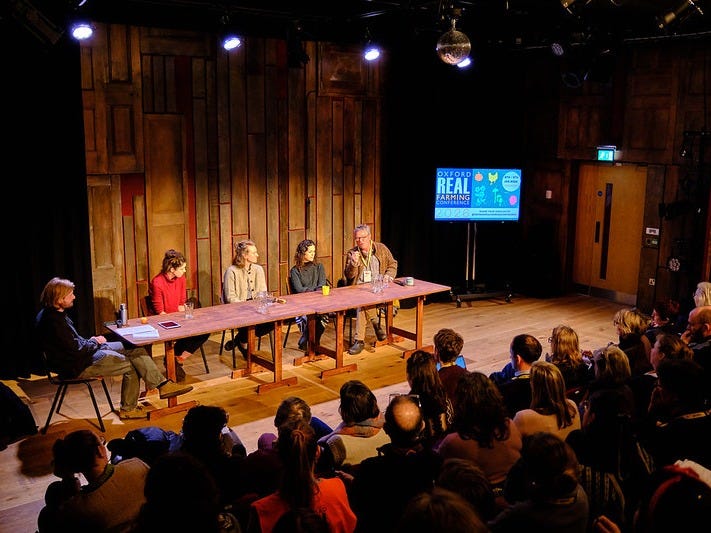
If I had endless money, I wouldn’t give up this work. I would do more of it. I have so much respect for my boss at Farms Not Factories because she self funds a lot of what we do. That kind of commitment is rare, and it is not something I take lightly.
It would be easier for me to switch this off and take a job doing social media and content creation for a business, or go full time influencer and sell shiny brands on Instagram or TikTok.
But that is not me. It will never be me.
I want better for my country, for our food systems, and for farmers everywhere.
If you want to support this work
If you’ve been reading for a while, thank you. If you’re new here, I’m glad you found your way in.
If you want to support this work, the simplest thing you can do is subscribe. Free subscribers help this writing travel. Paid subscribers fund the time it takes to keep doing it, especially in the weeks when life is heavy and I’m still trying to show up anyway.
And if you’re a farmer, a food business, a publication, or an organisation working in this space, and you need support with writing, comms, or social media, please do reach out. I can’t promise I can take everything on, but I can promise I’ll be honest.
One of the reasons I’m trying so hard to grow paid support here is simple. If my writing can cover more of my family’s basics, it gives me the breathing room to say yes to the farmers who really need help telling their story, even when they can’t afford to pay properly for it.
If you have the means and you want to work with me, that can look like paid work, or simply paying for a year of this newsletter. Either way, it keeps this work going, and it helps me keep showing up for the people I’m trying to speak for.
Make use of me while I’m still here doing this, because I’m trying very hard not to have to give it up.
Links
Climate impacts blamed as UK food self sufficiency drops to 60% - FarmingUK
UK has ‘no future’ if it fails to act on ecosystem collapse threatening national security - The Guardian
If just 5% of my readers tipped £1/$1 this essay would pay for itself in terms of time spent working on it.
Thank you so much. Yours is such an important voice. I’m sorry I can’t afford a paid subscription but this is partly because, when I can, I buy food from organic and small scale producers. I really wish this option was available to everyone. I used to teach English to refugees who came from countries where this was the norm and were frankly bewildered when they ended up stuck in English food deserts. Good luck with the book proposal. I know how horrible all the waiting is and especially the ghosting but I feel sure there are people out there who will recognise how needed your voice is.
Thank you for opening yourself up, Helen. Life seems to be asking a lot of you at the moment, so make sure you take some time for yourself.
You do a brilliant job of pulling apart complex policies into an essay I can understand. Are you a member of the British Guild of Agricultural Journalists? They accept comms people as members too, and they often send out opportunities to the network before posting wider.