

The store feels British. The supply chain is global.
That gap is not a mistake, it is the business model, reassurance up front, detail only if you go looking.

The first thing that strikes you about supermarket branding is how confidently it speaks. It does not whisper. It does not hedge. It does not say, this is complicated, or this depends on the season, or this varies by product line, or this is a mix of British and imported because the UK cannot grow everything all year round. It says proudly, boldly, in fonts designed to feel like chalk on a farmyard sign, that you are in the right place, that you are buying the right thing, and that the people behind the business have already done the moral and practical thinking for you.
I want to show you what I mean, because this week a creator I follow on Instagram posted a carousel of images from inside an Aldi store that captures the problem in one glance. I am sharing it here not to pick a fight with one supermarket, but because it is a perfect example of how corporate food sells reassurance first, and leaves the detail to be discovered later, if you have the time and energy to go looking.


That is why the Aldi images land so strongly. They are not a gotcha, and they are not coming from people with endless time and money to shop “perfectly”. They are a simple record of what many shoppers see every day, which is a store wrapped in the language of British farming and British quality, while the shelves beneath that language tell a much more global story. The point is not that imports exist. The point is that the branding is designed to float above the detail, and to make you feel as though the detail does not matter, or has already been taken care of on your behalf.
When you look through the gallery, what you are really seeing is the gap between a mood and a measurable claim. “Championing Great British Quality” is not a label. “Proudly supporting British farmers” is not a breakdown. It is not even a promise you can test, because it is not attached to a product, a percentage, a season, a category, or a price. It is a warm, patriotic atmosphere, and it works because most people are exhausted. Most people are trying to feed their families, keep their budgets under control, and make decent choices in a noisy world, and they do not have the time to interrogate every aisle like an investigator. Corporate food knows this. It sells reassurance first, and it sells detail only when it has to.
The reason I am writing about this now is that I get asked the same question, in different forms, over and over again. People see the flags, the tractors, the announcements about backing British farmers, and they want to believe it, because it would be comforting if it were true. I also think most everyday shoppers are genuinely trying to make better choices within the parameters they have, and the cost of living is high, and not everyone has the luxury of paying for organic, small scale produce from farmers markets every week, even if they want to. That is another story, but it is part of why this branding works. They want to believe that the big supermarkets, with all their power and all their public messaging, are quietly holding up the farming economy behind the scenes, even if individual farmers complain, even if food prices are volatile, even if the news is full of stories about hardship. They want to believe that the slogans mean there is a plan.
The question behind the Union flags 🇬🇧
A reader called Jillian Charlton left a comment under a post I wrote this week about the speed at which British farming is being hollowed out, and her question was the most ordinary, reasonable thing in the world. She had seen a Morrisons advert in Farmers Weekly and wanted to know whether the big supermarkets help smaller farmers, or whether they are just trying to sell as cheaply as possible. It is also the kind of question supermarkets actively encourage, because their own websites are full of pages about how they are “supporting the people behind the produce”, with photos, farm names, and a tone that suggests the support is built in rather than conditional. That question can sound naive if you have spent years watching how supply chains work, but it is not naive at all. It is the question the whole system depends on you not asking too loudly, because once you ask it, you start noticing how often the answer is hidden in plain sight.
The uncomfortable truth is that supermarkets do sometimes support British farmers, in some categories, in some seasons, for some suppliers, and that is precisely why the marketing is so effective. If the claim were always false, it would be easier to dismiss. Aldi is a good example of how this works, because it will name farms and picture farmers on its website, and it invites you to picture a certain kind of British farming when you see those faces and those place names. The catch is that these are not usually the small scale farms people imagine when they hear the phrase, they are often industrial scale operations that can deliver high yields at a price point the supermarket model demands. The problem is that the support is not automatic, and it is not built into the business model as a first principle. The business model is built on volume, price competition, and the ability to offer shoppers a sense of abundance all year round, and when those priorities come into conflict with British farming, it is British farming that is expected to flex, absorb the risk, and take the hit.
If the support was real, the outcomes would look different
If you want to see why this matters, you do not need to start with animal welfare, or climate, or the most polarising arguments in the food system. You can start with dairy, because dairy is not a lifestyle niche. It is not a trend. It is a staple that relies on daily logistics, processing capacity, and long-term investment, and when it breaks, it breaks in a way that is hard to reverse. Britain has lost 160 dairy producers in just six months. That figure should stop you, not because it is a nice line for social media, but because once farms go, they do not simply reappear when we decide we care about food security again. Skills disappear. Local processing disappears. Herds get sold. Whole communities lose the quiet infrastructure that keeps food moving.
This is where the supermarket slogans start to look less like support and more like a kind of emotional outsourcing. The branding invites you to feel that you are doing your bit simply by shopping where you already shop, and it invites you to treat the survival of British farming as a matter of consumer identity, rather than a matter of power, contracts, risk, and price. It says, you can keep buying exactly as you always have, and still feel like you are backing British farmers, because the store is wrapped in British farming imagery, and because the word “support” is doing a lot of work without ever being pinned down.
When pledges become brand assets
Once you start seeing that, you notice the same pattern in fast food and in corporate welfare pledges, because the underlying incentive is the same. A pledge is a brand asset. It is a story you can tell. It is a way to signal values without changing the economics, and the moment changing the economics becomes unavoidable, the pledge becomes negotiable.
This is also why the Better Chicken Commitment matters as a case study, even if you do not want to spend your life arguing about chicken. It was a commitment made in public, in language designed to reassure consumers and signal higher welfare, but it is also specific enough to test whether a company is willing to change how it buys. It covers stocking density, enrichment, and a move away from the fastest growing breeds, which is the part that really challenges the economics of cheap chicken. When companies sign up, they get to tell a story about values. When they deliver, they have to change purchasing and pay for it. Those are not the same thing, and the pledge only survives for as long as it does not threaten the model.
This is also where it helps to be precise about what “first” means, because corporate storytelling loves a first. Marks and Spencer is widely described as the first UK retailer to sign the Better Chicken Commitment, back in 2018, and it also says that its fresh chicken meets the criteria. Waitrose is described as the first UK retailer to fully meet the Better Chicken Commitment across all own brand chicken categories from September 2025. That distinction matters because it separates a pledge from delivery, and it reminds us that the gap between the two is where the truth lives.
The harder part is what happens when the pledge meets the purchasing department, and when the cost of delivery becomes real. Compassion in World Farming has published a summary of high street food brands that have backtracked on chicken welfare commitments, naming major chains as examples. You do not have to treat that as a morality play to see what it reveals. It reveals that the promise is public, while the retreat is quieter, and that the consumer is left with the impression that the pledge still means something, because the brand has already banked the trust.
If you have ever wondered why people feel so confused and cynical about food, this is part of the answer. It is not that consumers are stupid. It is that the system is designed to make trust feel effortless, while making verification feel like work. It is designed to make you feel that you are supporting British farmers because the store says you are, while the reality of sourcing, pricing, and farm viability sits elsewhere, in contracts you will never see, in margins you cannot measure, and in outcomes you only notice when the damage is already done.
That is why I do not think the right response is to tell people to shop perfectly, or to turn food into a purity test. Most people cannot buy direct for everything. Many people are stretched. Many people are feeding children, managing health issues, juggling work, and doing their best. The point is not to shame shoppers for living in the world we have. The point is to stop letting corporate food companies use British farming as a trust signal while treating British farmers as interchangeable suppliers in a global sourcing machine.
If a supermarket wants to tell you it is supporting British farmers, then it should be able to show you what that means in practice, in ways that go beyond the photogenic parts of the store. It should be able to tell you how much of each category is British, including processed and ready meals, not just the fresh meat and the seasonal produce. It should be able to tell you how farmers are paid, how risk is shared when weather wipes out a crop, and what happens when a supplier speaks up. If a company signs a welfare commitment, it should be able to tell you whether it delivered it, and if not, what changed, because the difference between a pledge and delivery is not a technicality. It is the whole point.
What it looks like to support British farming, for real
So what does actually support British farmers, in the real world, rather than in a slogan. It looks like buying direct when you can, because direct sales are one of the few places where the farmer has a fighting chance of setting a price that reflects costs. It looks like buying local when it is available, and treating seasonality as an honest signal rather than an inconvenience, because a food system that pretends everything is available all the time is a food system that will always lean on imports and cheapness to keep the shelves full. It looks like paying attention to origin labels rather than banners, and noticing when the mood of the store is doing more work than the facts on the packaging.
It also looks like insisting that this is not only a shopping question. It is a policy and power question. If we want British farming to survive, and if we want animal welfare and countryside outcomes that match the values we claim to hold, then we need a food economy that can pay for those things, and we need rules that stop the biggest buyers from shifting all the risk down the chain while borrowing the language of British farming to keep shoppers loyal.
Jillian’s question deserves a better answer than a shrug, because it is the question at the heart of food security, and it is the question that will keep coming back as more farms disappear. Supermarkets and fast food chains are very good at telling stories about who they are. The harder work is asking what those stories cost, who pays the bill, and what happens when the slogans meet the reality on the shelf.
If we do not insist on that distinction, we will keep being sold the story of British farming while the people doing the work are hung out to dry, and we will keep being told that the answer is to shop harder, rather than to demand a system that stops treating trust as a marketing tool and starts treating it as something you have to earn.
If this essay helped you see the gap between the story we are sold and the reality on the shelf a little more clearly, please consider subscribing.
Free subscribers keep the conversation going, and they help this kind of writing travel beyond the farming bubble, which matters when corporate food branding is shaping what the public thinks is normal. Paid subscribers fund the time it takes to do this properly, to follow the claims back to the sourcing, the incentives, and the outcomes, and to keep making the case for a British food system that does not treat farmers as disposable. If you are able to upgrade, thank you. It is one of the most direct ways you can support independent work that is trying to support British farming, without pretending a Union flag in an aisle is the same thing as a fair deal.
Links and coverage
British quality - Aldi
Supporting the people behind the produce - Morrisons
Britain loses 160 dairy producers in just six months - Farming UK
High-street food brands backtrack on chicken welfare - Compassion in World Farming
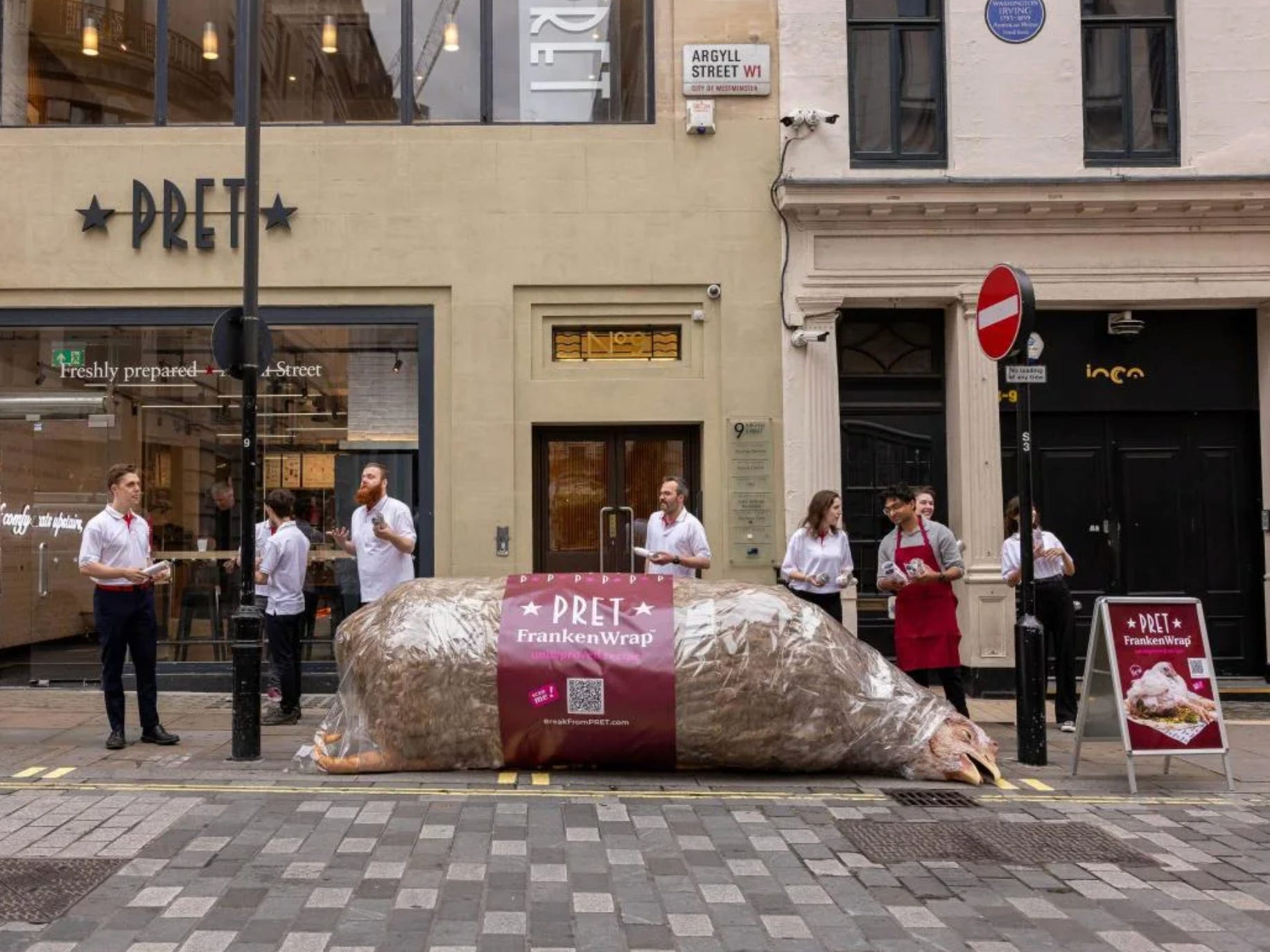
Londoners baffled as giant 'frankenchicken' appears at Pret in central London - Yahoo News
If just 5% of my readers tipped £1/$1 this essay would pay for itself in terms of time spent working on it.
Thank you Helen for a well researched and informative article. I feel a bit helpless in the face of this corporate power but I’m going to try and buy directly where I can and support British growers.
Great article Helen thank you. I’ve recently subscribed to a local veg box which supports local growers supplemented by wholesale goods in leaner months. I am happy to do this. I know the produce is great quality but I think there are barriers to its success. The first is that I get no choice in what I get. Yesterday’s box included Chinese cabbage which I dislike but will cook because I have it in the fridge. I think my support of this will ultimately lead to more food waste which is a shame. The second is cost. I get a veg box, a polytunnel box and four cartons of organic eggs for £49. I think that’s fine. My neighbour was horrified at the cost when I tried to get them to sign up. If you are used to shopping at aldi or Lidl this does feel like a lot of money. How do we shift the mindset?