

The Warning Is Clear. The Response Is Missing.
Farmers are already building resilience. Policy and markets still reward short term thinking.


No Drought About It was easy to miss. That is the problem.
A report lands that should be headline news for anyone who eats in the UK. It is clear, practical, and rooted in what farmers are already living through, yet it does not get treated like the moment it is.
It is not a secret plot. It is mostly the attention economy. We are drowning in crisis, and the loudest story wins the day. Meanwhile the slow moving risks that decide whether we can keep producing food in a volatile climate get filed under worthy, then forgotten.
The Soil Association report No Drought About It, Farming Agroecologically for Climate Resilience by Dr Hannah Blitzer and Maddy Potter Wood, makes the case that climate change is already undermining UK farming resilience. Food security is now tied to whether we build whole farm capacity to cope with heat, drought, and flooding, and whether we stop rewarding short term thinking that looks productive on paper while weakening the systems that help farms absorb shocks.
It is worth saying up front that this report has not been completely invisible. We shared it in the March Farms Not Factories newsletter with a simple line that still holds up.
“It is straightforward guidance on producing healthy food from resilient soils through mixed farming and diverse crops, while stepping back from chemical inputs and intensively reared livestock.”
Whatever your politics, you can see volatility in the fields. If you have been watching land sit under water all winter, then bake hard in summer, you do not need persuading that something has changed. What is harder is getting the rest of the food system to treat resilience as essential infrastructure rather than a nice to have.
Some people will call this climate change. Some will call it volatility. Some will call it a run of bad luck that keeps repeating. The practical question is the same.
How do we keep producing food when the seasons stop behaving.
What The Report Says
Soil is Not Just Dirt
Soils acts as water storage, flood protection, drought insurance, and a carbon bank. Healthy soils infiltrate and hold water. Degraded soils shed it. When soils fail, water takes the fastest path downhill, carrying nutrients and sediment with it. That is how you get flooded fields, stressed crops, polluted rivers, and a farming business that is always one extreme season away from the edge.
Livestock is Not a Simple Villain or Hero
The question is what system the animals are in. Industrial livestock production is framed as brittle and risk heavy because it concentrates animals, depends on imported feed, and locks farms into high input supply chains. By contrast, extensive and mixed systems can support resilience when they are aligned with rotations, forage, and nutrient circularity.
Trees Belong in the Working Landscape
Agroforestry is described as a climate solution that can cool microclimates, reduce flood peaks, protect soils, and support animal welfare through shade and shelter. It can also diversify income, but it needs long term support because trees do not pay back on the same timeline as annual crops.
Chemical Dependency is a Resilience Problem
This is not only an environmental argument. Synthetic nitrogen fertilisers and many pesticides are fossil fuel derived. Their prices and availability are vulnerable to global shocks. Their overuse can undermine soil biology and biodiversity, which then increases the need for more inputs.
That is a dependency loop, and it is not a stable foundation for food security.
Why This Keeps Getting Missed
That last point is where Maddy Potter Wood has been pushing the conversation, and I think she is right to do it. She argues that warnings like this can feel buried even when they are clear, practical, and urgent, and she uses current geopolitical tension as a news peg to underline a basic vulnerability.
We are already seeing how quickly that exposure can show up in farm costs, with the war in Iran and disruption around the Strait of Hormuz feeding through into fuel and fertiliser markets.
If your food system relies on fossil fuel based nitrogen, you are exposed to energy markets, trade disruption, and conflict far beyond your farm gate.
This week, The Times reported on a Defra commissioned assessment completed in 2024 which warned the UK could be at strategic risk of catastrophic failure in food, water, and natural ecosystems by 2030. The details are different, but the pattern is familiar.
The risk is not abstract. The risk is that we keep treating resilience as a side issue until it shows up as a price spike, a supply shock, or a political crisis.
The Ten Point Plan
The report is not vague. It sets out a Ten Point Plan for building climate resilience:
Develop a national resilience plan for farming - Work with the Climate Change Committee on an integrated plan that prioritises adaptation and mitigation. Include both green infrastructure, like nature based solutions, and grey infrastructure, like water reservoirs, for drought, heatwaves, and flooding. Break down silos across the UK and align policy, including whole farm planning and the goal of 10% organic farmland.
Strengthen soil protections - Develop Soil Health Action Plans with binding soil recovery targets so all soils are under sustainable management by 2035. Make farm payments conditional on basic good soil practice, and fund practices above that baseline. Tighten rules on high risk practices, like planting maize on floodplains and cultivating steep slopes.
Scale up climate friendly foods - Reduce reliance on fruit and veg imports from climate vulnerable countries by doubling land for horticulture and expanding support for agroecological, organic, and small scale growers. Increase demand for British whole and minimally processed foods by investing in beans, legumes, and other alternative proteins, and by scaling local and sustainable sourcing through public procurement.
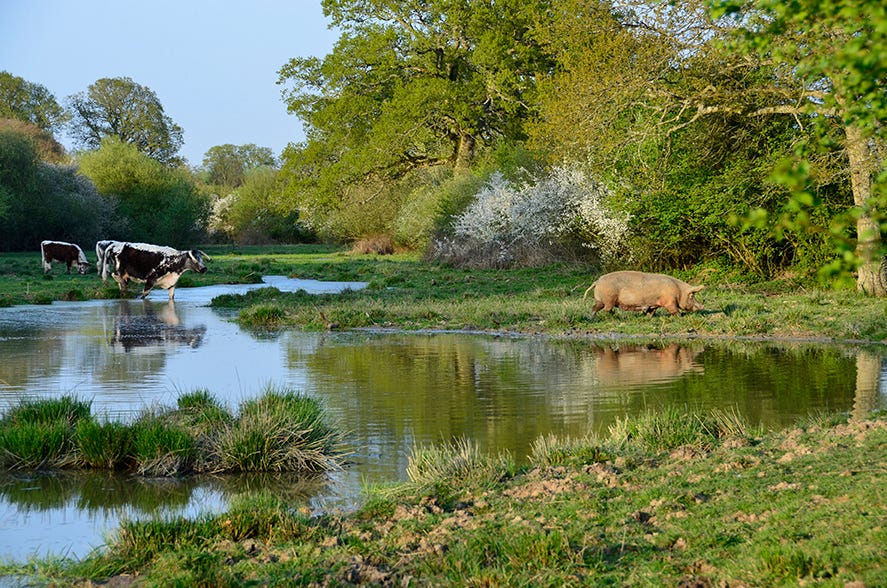
Mixed, integrated livestock systems like this one from The Knepp Estate can turn water, grass, and trees into resilience, when they are managed as part of a whole farm plan rather than an industrial input chain.
Reduce industrial livestock pollution - Incentivise mixed and extensive pasture based systems, and pair that with firm, fair regulation of industrial livestock. Use permitting thresholds and planning controls in nutrient overloaded catchments, and curb hidden support that masks the true costs of industrial models.
Reduce reliance on synthetic inputs - Promote organic and low input practices, including integrated pest management and extensive livestock, and improve nutrient cycling at catchment level. Cutting synthetic inputs reduces pollution, supports public health, and limits exposure to price shocks.
Scale up agroforestry - Expand agroforestry to 5% of agricultural land by 2030 and 10% by 2040, with half of all farms implementing it by 2050. Support whole farm, multifunctional systems such as silvoarable and silvopastoral, and provide long term funding. Remove barriers for all farmers, including tenants, and support new markets for UK grown woody products and nuts.
Improve monitoring and baselining, and use it in Whole Farm Plans - Invest in farmer led monitoring, verification, and reporting with robust indicators. Expand training, and consider making payments conditional on adopting monitoring. Integrate the data into whole farm planning so farmers can build resilience to economic and climate shocks while delivering public goods.
Make supply chains fairer for British producers - Ensure trade and tariff agreements uphold domestic standards and do not displace harms to climate vulnerable regions. Invest in regional food infrastructure, including local hubs, abattoirs, processing, and distribution, to diversify markets, support on farm value addition, and improve resilience.
Make private markets work for climate resilience - Strengthen governance of voluntary carbon and natural capital markets to reduce risk and enable credible blended public private finance. Markets can support land management change, but governance is needed to avoid unintended harms, including poorly designed offset schemes.
Invest in the right technology, infrastructure, and renewables for resilience - Fund research and innovation for on farm water storage, local renewable energy, and technology that aligns with agroecological principles. Avoid over reliance on unproven silver bullet solutions that deliver few multifunctional benefits.
You do not have to agree with every line to see the through line.
Resilience is not only about water availability and flood defences. It is about whole farm planning, advice, knowledge exchange, and fair markets that make it possible to adopt practices that keep soils functioning. It is about reducing exposure to input shocks, whether that is fertiliser prices, pesticide resistance, or imported feed risk.
It is about building systems that can take a hit and keep going.
If you do not work in farming, here is one concrete way to picture whole farm planning. It is the difference between reacting to each extreme weather event as a one off, and redesigning the farm so water has somewhere to go, soils can hold more of it, crops are less exposed, and the business is not forced into the most input heavy choices just to survive the season.
So Here Is My Ask
If you are reading this as a shopper, a cook, a parent, or someone trying to keep the food bill under control, please do not file this under interesting but not for me. Climate resilience is not a niche farming issue. It is one of the things that decides whether food stays available and affordable.
If you can, make one purchase this week that backs a farm or business building soil and diversity. That might be veg from a local grower, pulses, flour from a regional mill, or meat and dairy from a genuinely pasture based system. You are rewarding the direction of travel.
And if you buy from a veg box, farm shop, butcher, market stall, or even a supermarket, ask one simple question. Where is this grown, and what is the farm doing to protect soil and water. You are signalling demand for resilience, not just price.
Do not let this disappear under the next crisis.
And if you have seen organisations respond already, please add links. I would genuinely like to build a public trail of who is amplifying this and what they are saying, because that is how we turn a report into pressure, and pressure into policy.
Helen’s Perspective
When I say reports like this get buried, I am not trying to sell you a conspiracy. I am trying to name a pattern.
Anything that offers practical steps to avoid shortages and reshape the food system tends to be treated as optional, or ideological, or too difficult to do at scale. Meanwhile the risks keep stacking up, and we act surprised when food prices jump or shelves thin out.
A Defra commissioned assessment finished in 2024 warned that the UK’s food, water, and natural ecosystems could be at strategic risk of catastrophic failure by 2030. That is an extraordinary thing to write down in a government report, and yet it did not sit at the centre of public debate. It surfaced as a scoop, then drifted away again.
At the Soil Association, none of this is new territory. No Drought About It lays out the same direction of travel in plain English. Climate change is already pressuring farming through soil degradation, water scarcity, and more volatile seasons, and those pressures do not stay on farms. They show up in the price and availability of food.
The latest geopolitical conflict in Iran adds another layer, because it highlights a weakness we rarely talk about honestly. The UK food system is highly reliant on fossil fuel based nitrogen fertilisers. That leaves farmers and consumers exposed to global market shocks and supply disruption, while also increasing emissions and pollution.
The frustrating part is that this is not a problem with no answers. Farmers are already working on solutions that reduce dependency and rebuild resilience. Low input, agroecological, and organic systems restore soils, rebalance natural processes, and reduce reliance on synthetic fertilisers. Scaling those practices is not a lifestyle preference. It is a proven pathway to strengthening long term food security.
So my question is not whether we can do this. It is whether we are willing to treat resilience as essential infrastructure, and stop rewarding short term thinking, backing a transition to farming systems that work with nature rather than against it before the next shock forces our hand.
Sources
No drought about it: Farming agroecologically for climate resilience - The Soil Association
How the war in Iran is already affecting UK farmers and food production - The Conversation
Britain’s food supply ‘at risk of catastrophic failure by 2030’ - The Times
If just five percent of my readers tipped £1 or $1, this essay would pay for itself in terms of time spent working on it.
I grew up on a 200 acre farm. It was well diversified. We rotated religiously, corn followed by soybeans, pasture, hay and oats. We were a self sustaining farm. We had 6 to 8 milk cows, a dozen or so hogs, stock cows ( mostly Hereford and Angus cross), we raised 75 pullets every spring (for meat and for free range laying hens,) and finally because we lived in very cold climate we’d have them inside during some of the winter months. In the spring, we would spread the manure from the barns, hog pens and chicken house on the land, along with the hoof work,the animals performed made a very fertile land. I do believe the climate is changing and that fact can be used to our advantage. I don’t put a lot of stock in climate change. The climate is always changing. I have seen and lived what resilience looks like and what actually works. We can make it through this time and we will, I strongly believe, if we keep the bureaucratic unnecessary regulations out of the equation. We can build a more resilient farming community. I had to sell our 100 acres in Iowa because it had fallen to the 5000- 10,009 acre behemoth mentality. They would work like madmen for two weeks in the spring to get the crop in (with enormous input cost) and then go to town to drink coffee until it was time to repeat the same thing in reverse for the fall harvest. It was no longer a way of life. It had become purely extractive and America’s largest welfare program. The attempt was to satisfy the natives with cheap and less than nutritious foods. We actually measured top soil in feet, and lived in a very blessed time that has all but disappeared.