



A report like this is easy to skim. You see the headline number and you move on.
This one models what could happen if Great Britain ends up applying EU decisions on plant protection products through a future UK-EU SPS agreement (Sanitary and Phytosanitary Agreement), and if that alignment is done in a way that creates a sudden cliff edge.
On paper, the headline figures are hard to ignore.
The report suggests farm sector profit could drop by £500 million to £810 million in the first year.
Before we go any further, I want to be clear about where I am coming from. I am not defending chemical dependence. I am arguing for a managed transition.
Because if you remove tools faster than we can replace them with better systems, the pressure does not disappear. It moves. And it usually moves onto standards, onto small farms, and onto consumers.
This report was commissioned by CropLife UK and written by The Andersons Centre, and it is clear about what it is and what it is not. That does not make it worthless. But it does mean we should read it with our eyes open.
It is a desk based model built from public data and interviews with agronomists and industry experts. It is not a set of UK field trials where crops are grown under EU only rules and compared side by side. It also only models a selection of crops, and the authors say that means the totals are likely to be an underestimate rather than a full picture. It also matters that the headline loss is tied to a specific policy design choice.
The baseline scenario is an immediate cliff edge where EU decisions and MRLs override existing GB decisions at the point an SPS agreement starts, including retrospective alignment of the divergence that has built up since Brexit.
That is a worst case by design.
And the report’s own mitigation options, delay or managed alignment through renewals, are really an argument about sequencing.
Not an argument that change is impossible. If you stop there, it sounds like a farming story. But it is not really. It is a supermarket story. It is a food system story. And it is about what happens when policy is treated like a switch you can flick without consequences.
Because the headline figures are only the surface. The real question is what sits underneath them, and who ends up carrying the risk when the rules change.
What Plant Protection Means, Without The Jargon
Plant protection is the umbrella term for the tools and rules that stop crops being wiped out by weeds, insects, and disease. That includes chemical pesticides. But it also includes biological products, seed treatments, and the practical permissions that decide what can be used, when, and on which crops.
This is about regulation and risk management as much as it is about chemistry. When a tool is removed, farmers do not stop trying to grow food. They adapt. Sometimes that adaptation looks like higher costs, more labour, more machinery passes, different rotations, lower yields, or more waste. And those costs do not stay on farm. They show up somewhere else: tighter margins, higher prices and more imports. Or in a quiet lowering of standards that nobody advertises.
Why This Matters To People Who Do Not Think About Farming
The report is about a possible UK-EU deal that could change which plant protection tools are available in Great Britain.
The authors focus on one particular risk. A future SPS agreement could create one shared rulebook, and the UK could choose to apply EU decisions not just going forward, but backwards too. They call that retrospective alignment.
In plain terms, it means products that are currently legal in Great Britain could become unavailable quickly, not because the science suddenly changed, but because the rulebook did.
The report argues that GB and the EU are still operating essentially the same legal and scientific approvals system, just in different contexts. So the immediate risk here is not a sudden new discovery about safety. It is a policy choice about how quickly to treat past divergence as if it never happened.
The Bit Consumers Miss, Which Is The Bit That Matters
A lot of everyday supermarket food is built on arable crops. Not just bread and pasta and breakfast cereals, but biscuits, cakes, beer, and the ingredients that sit quietly inside ready meals. Arable crops also supply animal feed, which means they sit underneath meat and dairy too. So when people talk about food security, it is not only about whether we can grow carrots.
It is about whether we can keep producing the basic building blocks of the modern diet without lurching into more imports and more volatility. And it is about what kind of food system we end up with when the pressure rises.
If you want the blunt version of what I think this means for standards, imports, and small farms, that is below.

What A Managed Transition Could Look Like
When I say managed transition, I do not mean pretending there are no trade offs. I mean avoiding a policy design that creates an instant scramble.
In practice, that could look like this.
No retrospective cliff edge - Existing GB decisions stay in place until they come up for renewal, rather than being overridden overnight.
Clear timelines and notice - If a tool is likely to be removed, farmers and supply chains get enough lead time to plan rotations, contracts, and alternatives.
Support for alternatives and adaptation - More investment in integrated pest management, resistant varieties, agronomy advice, and practical on farm trials, so we are replacing tools with better systems rather than just removing them.
Honesty about imports and standards - If policy shifts increase import reliance, we should be upfront about what that means for standards, enforcement, and resilience.
Helen’s Perspective
I want to say this as plainly as I can.
Most people will skim a report like this and either shrug, or get stuck on the word pesticide and switch off. But the reason it matters is not because I want anyone to feel sorry for farmers. It matters because the crops this report is talking about are the building blocks of the modern supermarket diet.
So when we treat crop production as a niche farming issue, we are kidding ourselves. This is a supply chain issue. And it is a cost of living issue.
Here is the bit that makes me uneasy.
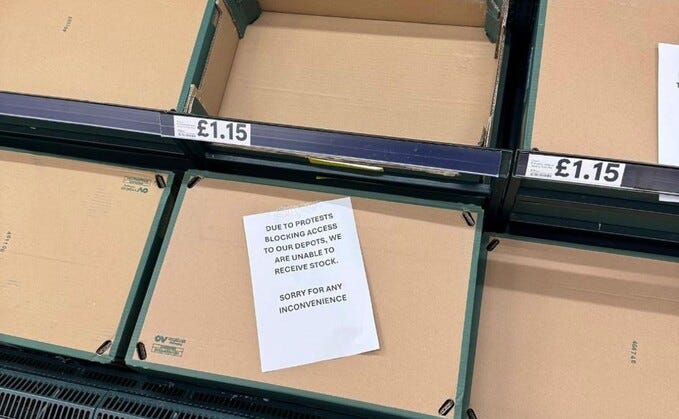
If we make domestic production harder and less predictable, the system does not respond by becoming kinder or more sustainable. It responds by importing more. And the report is blunt that this is the assumption.
The UK consumer is wealthy enough to outbid others for food, so the shelves will probably still be full.
But the trade deficit grows, the supply chain becomes more exposed to shocks, and we quietly lose the capacity to produce the basics at home. There is also a standards problem that nobody wants to say out loud. If we end up relying more heavily on imports, we are not just swapping geography. We are swapping who carries the risk, and what standards are actually enforced in practice.And if our own rules shift in a way that lowers the bar or creates a race to the bottom, then the cost of farming to better practice rises again.
That is when the squeeze really bites.
Supermarket supply chains are already ruthless. When margins tighten, farmers do not get paid more for doing the right thing. They get told to do it cheaper. Cheaper methods are not always reflected in supermarket prices. Food prices rise with inflation, but farmers rarely see that increase as profit.
So the pressure stays on farm.
And when the pressure stays on farm, the farms that go first are often the ones with the least buffer: Smaller farms, New entrants, The people trying to do organic or regenerative without a corporate backstop.
That is not because they are bad at farming. It is because the system is designed to reward scale, uniformity, and volume. We are already struggling as a nation to rely less on ultra processed food and supermarket convenience. If domestic farming becomes less resilient, and if supply chains become more import dependent, the default is more cheap, shelf stable calories.
That is not a conspiracy. It is what the system does when it is stressed. So yes, you can argue about the modelling. You can argue about whether the loss is £500 million or £810 million. But the bigger question is whether we want food policy made on a cliff edge.
Or whether we want a managed transition that is honest about trade offs, honest about who pays, and serious about protecting the long term health of the food system.
If you want trust, you cannot keep asking farmers to be world class while treating them like a cost to be managed.
Sources
https://croplife.co.uk/media/bsypavzi/croplife-uk-the-andersons-report-2026.pdf