

This Is What No Response Looks Like
The Warning Was Clear. The Response Is Still Missing.


I wrote this a couple of weeks ago, to go live before Easter, but I got sick and it sat in my drafts. The headlines I am pointing to are slightly older now, but the pattern has not changed. If anything, it has become harder to ignore. The warning is still clear, and the response is still missing.
Last week I wrote that The Warning is Clear. The Response is Missing. Farmers are already building resilience, but policy and markets still reward short term thinking.
One story landed this week that says a lot about what the system rewards, vegetables being sold for 4p ahead of Easter. It is not happening in isolation. Two other very recent pieces, on input shocks and on ignored warnings inside government, help show what sits behind it.
The other two pieces are about war and shipping routes, and about a government report that seems to have vanished into a drawer. Put alongside the 4p headline, they start to look less like separate stories and more like a system that keeps rewarding short term thinking.
When Costs Jump, Everything Jumps
The Conversation reported that the conflict in Iran and disruption around the Strait of Hormuz is already feeding through into UK farm costs. Red diesel, the rebated fuel widely used in agriculture, has risen by around 60%. Fertiliser markets are moving too. The UK imports around 60% of its nitrogen fertiliser, and around one third of global fertiliser trade passes through the Strait of Hormuz, which makes prices highly sensitive to disruption.
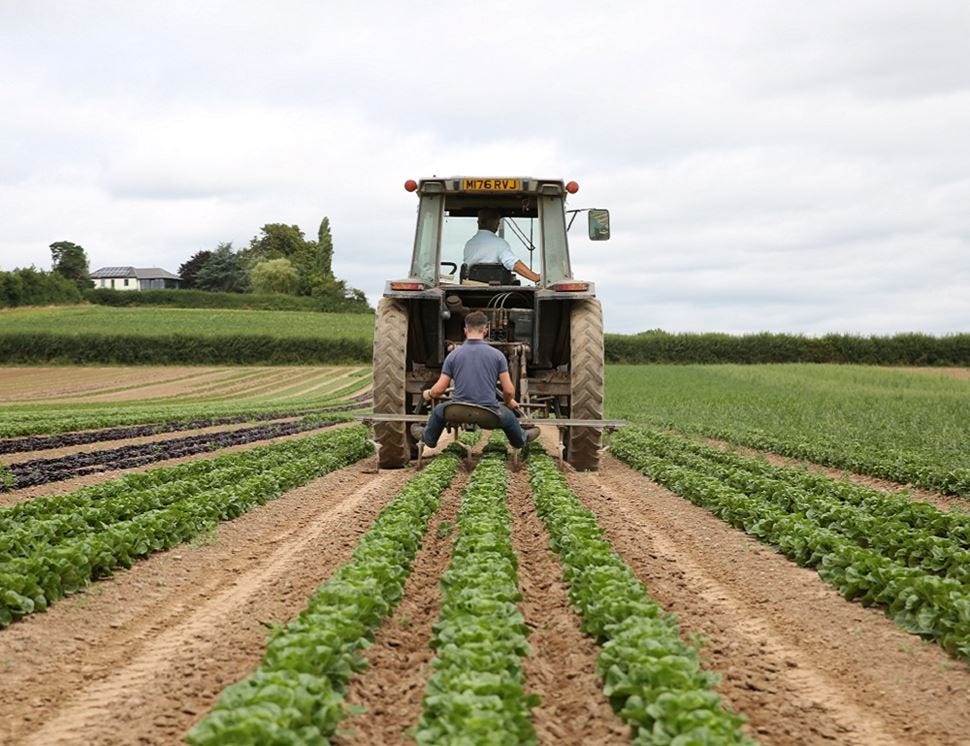
This is the part that is easy to miss if you do not work in farming. Synthetic nitrogen is not just a line on a farm budget. It is one of the foundations of modern yields, and it is fossil fuel linked. When energy markets or trade routes wobble, the cost of growing food wobbles with them.
That does not mean farmers are helpless. Many are already reducing dependency where they can. They are building fertility through rotations, legumes, composts, manures, grazing, and better soil management. But those changes take time, knowledge, and often a period of lower output while the system rebalances.
If the wider food economy is set up to punish any dip in yield, or any increase in cost, then we are asking farmers to do a transition with one hand tied behind their back.
A Report that Should Have Changed Everything
The Times reported on a DEFRA commissioned assessment completed in 2024 which warned that Britain’s food supply, water supply, and natural ecosystems were on a decline and collapse trajectory , with a realistic possibility that by 2030 they could be at strategic risk of catastrophic failure .
That is an extraordinary thing to write down in a government report. The most unsettling part is not the wording. It is what happened next. The report did not sit at the centre of public debate. It surfaced as a scoop, then drifted away again. The DEFRA Futures team was disbanded the following spring, and when the report was requested under Freedom of Information the government claimed to have no record of it.
Slow moving risks that decide whether we can keep producing food in a volatile climate get filed under worthy, then forgotten, until they show up as a price spike, a supply shock, or a political crisis. Then we act surprised, and we reach for emergency measures, and we call it resilience.
Resilience is not an emergency response. It is a design choice.
Cheap Veg is Not the Same as Affordable Food
And then there is the story that looks small, but tells you a lot about what the system rewards.
Farmers Guardian reported that Aldi, Lidl and Morrisons have cut the price of seasonal vegetables to 4p ahead of Easter, with Tesco and Sainsbury’s at 15p per item, and Asda was offering five for £1, which is 20p per item. The British Growers Association chief executive Jack Ward said “growers have seen this pattern for years”, and asked the obvious question. Retailers are prepared to invest in drastically reducing prices, but are they prepared to invest in farming and make sure growers are properly rewarded for the increased costs.

Veg at 4p might look like a bargain, but it sends a dangerous message that food has no value. Nobody blames shoppers for taking a deal when times are tight. But when produce is sold for pennies, the real cost does not disappear. It always lands somewhere else in the system.
Sometimes it lands on growers through contract pressure and risk shifting. Sometimes it lands on farm shops, veg box schemes, and local greengrocers who simply cannot compete with a loss leader. Sometimes it lands on the long term health of local supply, because if the public is trained to expect vegetables for pennies, then the businesses trying to grow and sell them have to fight uphill for every pound.
Farmers Guardian also noted that growers raised concerns at Christmas when festive staples such as Brussels sprouts dropped to below 8p per kg. Now it is 4p at Easter. That is not a one off, that is a direction of travel.
Fresh vegetables are often used as a loss leader , meaning they are sold extremely cheaply to get people through the doors, in the hope they will spend on higher margin items. Supermarkets say farmers are paid as per contract and are not financially impacted by the low retail price.
A loss leader is not a mystery. It is a deliberate choice to sell something essential for next to nothing because it gets people through the doors, and because the supermarket can make the money back elsewhere. It works because vegetables feel like a moral good. A bag of carrots at 4p looks like kindness in a cost of living squeeze, and it gives the retailer a glow of generosity while the real margins sit in the rest of the trolley.
The defence you will hear is that farmers are paid as per contract, so the grower is not affected by the sticker price. Sometimes that is true in the narrowest sense. But the sticker price still does work. It tells shoppers what food is supposed to cost. It tells every other seller in the chain what they are competing with. It tells growers what kind of retail culture they are trying to survive inside.
This is What No Response Looks Like
When I was farming pigs, I learned quickly that the numbers do not care about your intentions. If you are being squeezed on price, you do not just lose profit. You lose room to breathe. You delay repairs. You stretch feed. You put off investments that would make your system sturdier next year. You take on more risk because you have to keep cash moving. That is how a business becomes brittle.
So when vegetables are priced like a joke, it is not only an insult. It is a signal that the system is still designed to treat food as a marketing prop, not as essential infrastructure. And that is exactly the mindset we cannot afford if we are serious about resilience.
We cannot build food security on a foundation of volatile inputs, ignored risk assessments, and a retail culture that treats vegetables as disposable.
My Small Ask
If you are reading this as a shopper, a cook, a parent, or someone trying to keep the food bill under control, please do not hear this as a lecture.
If you can, make one purchase this week that backs a grower or a local supply chain that cannot compete with loss leader pricing. That might be veg from a market stall, a veg box, a farm shop, flour from a regional mill, or meat and dairy from a genuinely pasture based system.
And if you do buy veg from a supermarket this weekend, ask one simple question. Where is this grown, and what is the farm doing to protect soil and water. You are signalling demand for resilience, not just price.
If you missed my paid post on the Soil Association’s No Drought About It report, that is where I set out the practical, farm level side of this story, what resilience looks like when it is built deliberately rather than improvised in crisis.
The Warning Is Clear. The Response Is Missing.

No Drought About It was easy to miss. That is the problem.
If this work is useful to you, the simplest way to support it is to become a paid subscriber. It funds the time it takes to keep researching, writing, and publishing independently.
Sources
No drought about it: Farming agroecologically for climate resilience - Soil Association
How the war in Iran is already affecting UK farmers and food production - The Conversation
Britain’s food supply ‘at risk of catastrophic failure by 2030’ - The Times
Major UK supermarkets criticised after reducing price of veg to 4p over Easter - Farmers Guardian
If just 5% of my readers tipped £1 or $1, this essay would pay for itself in terms of time spent working on it.
Another great article. Do you know what Sainsbury’s reputation with farmers is? My local store has recently put up a huge poster boasting about their long term relationships with farmers and were even making announcements over their PA system on the same theme. I’m guessing this is hogwash but as I’ve never had to deal with Sainsbury’s I don’t know.
That so few of us are watching the hit our farmers will take from the gathering fuel crisis makes me shudder. I am glad we already use chicken manure and crop rotations for our fields but we sure do still use a lot of diesel.
It feels like it is all colliding in mid air in slow motion. The whole lot coming to a peak at once. I wish I was on my own farm frankly - not dependent in the suburbs for another year.