

This Roadmap Doesn’t Fix Farming. It Reorganises Who Pays.
A framework heavy on vision and light on delivery, with private finance and supply chains expected to replace public support over time.

A new government roadmap always arrives wrapped in comfort words, the kind that sound like a hand on the shoulder. Long-term, joined-up, flexible, no one-size-fits-all, confidence to plan and invest.
Defra’s Farming Roadmap 2050: Growing England’s Future is full of those words, and some of them matter. Farmers have been begging for certainty because the ground keeps shifting under them, with subsidy rules changed at short notice, new tax signals landing mid-planning cycle, and climate impacts that now rewrite the season year on year. You cannot run a business on permanent policy churn layered on top of volatile markets, volatile weather, and volatile input costs. The press release sells this as “certainty beyond the next harvest”, and as the most significant moment for English agriculture since the Second World War.
But the Roadmap’s real message is not the headline vision. It is the direction of travel on who carries the bill.
This is a plan for a managed transition away from broad public support, towards a system where more of what is currently paid for becomes a regulatory baseline, and where private finance and supply chains are expected to replace public money for routine “good practice”. That might be coherent on paper. The question is whether it is deliverable in the world farmers actually live in, and whether it strengthens UK food security and self-sufficiency, or quietly makes it harder.
If you want the longer version of the argument about why delivery and trust matter more than new boards and new language, my earlier piece Farming Is Not a Spreadsheet.
If you want more writing that follows the money and names who carries the risk, subscribe for free so you don’t miss the next post.
And if you can support the work as a paid subscriber, you’re helping me keep it independent, and keep it free to read.
What the Roadmap says, and what it avoids
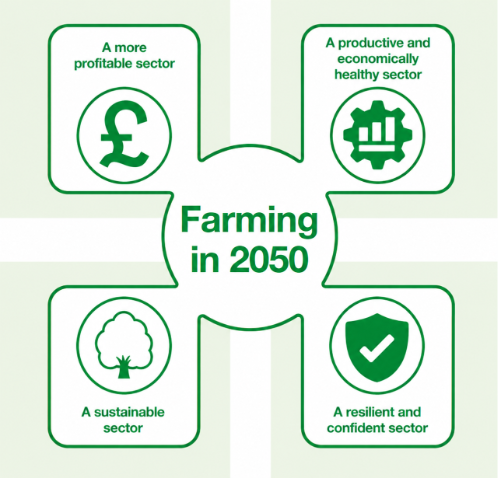
Defra is explicit that this is not a prescriptive route map for every farm. It is a long-term framework that tries to hold together four outcomes, profitable, productive, sustainable, and resilient, while leaving different systems room to adapt.
That sounds sensible, but it also means the Roadmap is heavy on direction and light on the hard bits farmers measure in cashflow. Dates, payment levels, enforcement, and who is accountable for what, and by when. A framework cannot pay a bill, and it cannot enforce a contract.
A framework, not a delivery plan
The Roadmap positions government as strategic and interventionist in places, shaping markets, investing in skills, data, technology and infrastructure, and reforming regulation.
It also signals a clear intention to step back over time. Public payments are framed as time-limited for mitigation and transition actions. As practices become “standard”, support is expected to reduce, with regulation, supply chains, and private markets doing more of the work.
Government as “active partner”, then stepping back
Alongside the long-term framing, Defra’s press release lists a set of near-term measures it presents as the practical response to the Farming Profitability Review. These include:
Extending fair dealing regulations to egg producers and fresh produce
A task-and-finish group to unlock private investment in sustainable farming
A UK–EU Sanitary and Phytosanitary agreement to cut export friction
Opening the new SFI26 application window to all eligible farmers
A £30 million Farmer Collaboration Fund to support groups of farmers to grow their businesses
Moving the Groceries Code Adjudicator to Defra for a more “joined-up” approach
Considering changes to the National Planning Policy Framework to support farm infrastructure
Some of these could help. The question is whether they change power and risk in the supply chain, or whether they mainly create new structures and new language while the fundamentals stay the same.
The immediate actions, and what they actually change
The Roadmap frames ELM schemes as the main tool for paying for public goods now, while also setting up a shift.
Farm Gate’s summary of the Roadmap, by Ffinlo Costain, describes three phases:
2026: a simpler, fairer SFI opening for small farms and those without existing agreements, then extending to all eligible farms
2027 to 2029: greater stability in scheme design, consolidated capital grants, and increasing spatial targeting, with a commitment for the ELM budget to reach £2 billion per year by 2029
Beyond 2030: a refocus on “genuine public goods” markets cannot fund, with mitigation and conversion actions expected to phase out of public payment as they become embedded in regulation or supply chain requirements
The Roadmap is candid that by 2030, practices currently incentivised may need to become regulatory baselines, particularly around water quality, air pollution and emissions.
ELM as the bridge to a post 2030 settlement
The “profitable and productive” theme leans hard into innovation, technology, skills, planning reform, export opportunities, and a new Farming and Food Partnership Board to co-ordinate Sector Growth Plans, starting with horticulture and poultry.
It also flags a Sanitary and Phytosanitary agreement with the EU to reduce trade friction, and legal protections for egg and fresh produce growers against unfair supply chain practices.
All of that is plausible. None of it, on its own, fixes the core farm gate problem, which is that too many farmers are expected to be world class businesses inside a supply chain that still pushes risk downhill. Boards do not stop a last-minute spec change, a rejected load, or a late payment.
The real story under the Roadmap
This is where the Roadmap stops being a vision statement and becomes a bet: that private markets and supply chains will replace public support quickly enough, fairly enough, and at scale, as more “good practice” becomes baseline expectation. Nature markets, carbon markets, biodiversity net gain and catchment payments are presented as the post‑2030 settlement, but that shifts power towards contracts and standards, and towards whoever has the staff, capital and leverage to manage them.
Farm Gate’s Groundswell panel discussion captures the core worry: the Roadmap signals stability while also signalling withdrawal after 2030, and there is no evidence private finance will fill the gap at the pace implied. Add spatial targeting and you risk a postcode lottery. Add weak enforcement and you keep an extractive supply chain intact. Food security looks like a full shelf, but it starts with whether farms can survive long enough to adapt, and whether anyone is actually accountable when delivery slips.
The real test: who pays, and who has to deliver
One of the clearest reactions I saw came from farmer and author James Rebanks, responding to Defra and Natural England’s insistence that profitable farming and nature recovery “go hand in hand”.
He’s one farmer, not the whole sector. But he puts his finger on the same missing middle that comes through, in more polite language, in Farm Gate’s Groundswell panel discussion.
If you want more nature, you have to tip the scales. That means money from markets or government, or rules that force the market to pay, or both. If you are not prepared to do that, then “we want food and nature” is just a wish.
As Rebanks put it, “Unless you are prepared to pay enough one way or another to tip the scales to create more nature, then there is no way you’re getting that outcome.”
That is the question this Roadmap keeps circling without answering. It tells farmers to plan and invest, while also signalling that more of today’s paid actions will become tomorrow’s baseline obligations, and that private markets will fill the gap. The direction might be coherent. The funding and enforcement story is still missing.
Helen’s perspective, why this feels like a handover
I’ve put a “Helen’s perspective” section behind a paywall in the past, because I’m doing this on my own, and I needed a way to keep going.
I’m changing that now. I want this work to be free to read, and paid subscribers are supporting the reporting so I can keep it that way.
The Roadmap is building a future where farms are expected to be data-ready, inspection-ready, finance-ready and contract-ready. That future runs smoothly for large commercial farms and for corporate supply chains, because they already have the staff, capital and leverage to meet endless standards, absorb admin, and negotiate terms.
The risk is that small and medium family farms become the residual category. They either comply at their own cost, sell environmental outcomes to plug the gap, or quietly exit. Not because they are bad farmers, but because the system is being designed around audibility and invest-ability, and around buyer standards that can be changed at any time, rather than around fair margins at the farm gate.
That does not have to be the end point, but it will be unless Defra stops treating “fairness tools” as a talking point and starts using them like tools. Fair dealing rules have to bite. Tenancy reform has to unlock real security to invest. Advice and schemes have to work for people without an office team. And if paid actions are going to become regulatory baselines, then government has to publish clear, workable timelines and fund the transition properly.
Because without that, this Roadmap does not build a partnership. It builds a handover, shifting cost and responsibility from the state onto farmers, while corporate food keeps the leverage and takes the gains. It doesn’t build a farming future, it builds a corporate food future, and it asks small farms to carry the friction.
That matters for pieces like this, because the Farming Roadmap is not just a policy document. It is a statement about who carries risk in the next phase of English farming.
If government wants to phase out payments for “mitigation” and “conversion” as practices become standard, then it has to be honest about what replaces them. Regulation is not free. Private markets are not guaranteed. Supply chains do not become fair because a board exists.
If we want a profitable, productive, sustainable and resilient farming sector, we have to stop pretending that farmers can absorb every extra cost while supermarkets and processors keep their margins protected.
And we have to stop treating small-scale, tenant, and agroecological farms as optional extras. They are part of the resilience story, and they are often the first to fall when policy becomes complicated and markets stay extractive.
So here is my ask
Whoever you are in this system, the question is the same. What replaces the money, and who carries the risk while we find out.
If you are a farmer reading this, do not let anyone tell you the only choices are to scale up, intensify, or get out. But also do not accept a future where the state steps back, the market stays extractive, and the risk quietly transfers onto you.
If you work in policy, comms, or the NGO space, stop treating “private finance will fill the gap” as a magic sentence. Show your workings. What markets, what standards, what governance, what timeline, and who carries the risk if it does not materialise.
And if you are reading this as a shopper, a cook, or someone trying to keep the food bill under control, remember this. A Roadmap is not food security. Food security is whether farms can survive long enough to adapt, and whether the supply chain pays for the kind of farming we say we want.
If you have read the Roadmap itself, or you have seen organisations respond with specifics, please add links in the comments. I want to build a public trail of what is being promised, what is being funded, and what is being quietly shifted onto farmers.
Links and coverage
Defra Roadmap PDF: Defra Farming Roadmap 2050
Defra Farming Blog: The Farming Roadmap (24 June 2026)
Defra: Government response to Baroness Batters’ Independent Farming Profitability Review (PDF)
Farming Is Not a Spreadsheet

This report did not land with a bang. It landed with a thud, because it was delayed, drip fed, and treated like something to be managed rather than something the country needed to hear.

If just 5% of my readers tipped £1/$1 this essay would pay for itself in terms of time spent working on it.